Having a differentiated message for your solution is critical to your success. It allows you to articulate why your product is the best solution to solve a customer’s pain points and why they need to buy your solution today. A crisp message helps you win your share of the deals. Having a very sharp message is even more important in these times when the budgets are tight.
Here is the framework I have used when working with my clients to build a very sharp product message.
- Step 1: Develop detailed personas – for each persona, define their role, their day-in-life, their key metrics, their challenges and how your solution category will address their issues. Note: this is an important starting point and take the time to do this right. In a future blog post, I will share a framework for developing personas.
- Step 2: For the target persona, make a list of all their pain points. Then categorize them (and continue to refine the pain points and categories) until you end with three mutually exclusive categories, and you feel good about the structure.
- Step 3: Populate your messaging worksheet from left to right, which has these columns: Pain category, list of pain points for each category, product features that addresses pain points, unique differentiated features (if any), benefits from features, KPIs and value, and customer proof points. See the worksheet below. Keep refining this worksheet until you feel good about it.
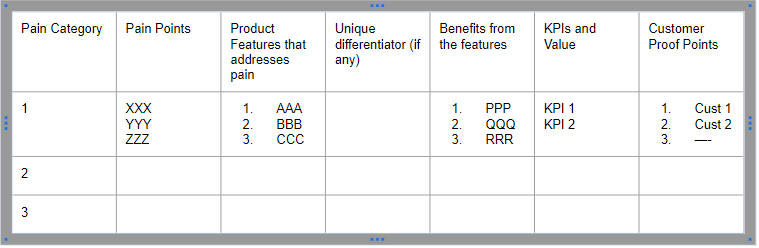
- Step 4: For each pain category in the worksheet, summarize in clear text (move from right to left columns) a) the outcomes your product delivers (from the columns with combination of benefits, value, and proof points), b) the key capabilities that deliver these outcomes (from the column of features and unique differentiators) and c) the problems your solution solves (from the column containing pain points).
- Step 5: Refine the summary created in step 4 until it is succinct. Remember, this is still at the pain category level.
- Step 6: Take the summary one level up by aggregating the multiple pain category summaries into product level message, which summarizes a) the outcomes your product delivers b) the key capabilities that deliver these outcomes and c) the problems your solution solves. Keep refining it until you find your product message to be very succinct.
- Step 7: The message developed above should allow you to answer two important questions for the target persona – Why buy and why buy mine? But now work on adding to the message (that you have created from step 1 to step 6) an answer to the third question – it has always been important and is even more important now – Why buy now? You can use the KPI and proof points from the messaging worksheet to craft it and add this to the message.
The message house (message house is a collection of key messaging for each of your products for each of the personas), once constructed, is the starting point for all your marketing activities. It helps your corporate marketing, field marketing and sales articulate the solutions consistently and correctly via all communication channels – their PR activities, customer conversations, sales pitches, enablement content, industry presentations, website, marketing campaigns, marketing content, collateral etc.
Here is to a solid messaging for your product!
As always, if you have any questions or feedback, please message me at https://www.linkedin.com/in/applicationsmarketing/
 All Things SaaS
Leave a comment