In the last blog post, I discussed the value of ‘land and expand’ analysis of your sales transaction data. We discussed how it can help you sharpen your go-to-market execution, increase ACV (Average Contract Value) and create more effective customer marketing programs, among other benefits. Today I will discuss a secondary advantage of analyzing sales transaction data – white space analysis.
What is white space analysis?
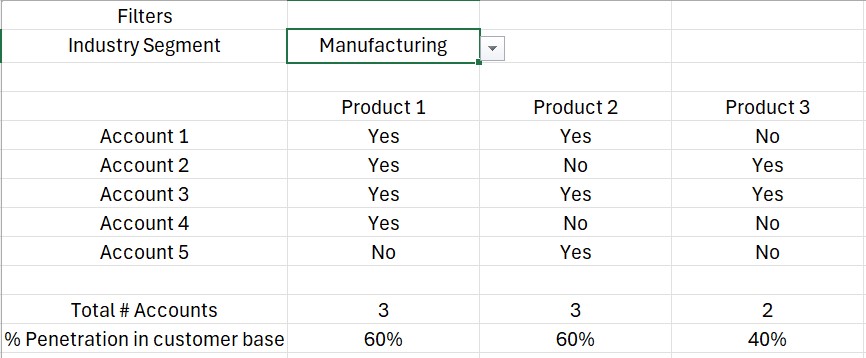
White space analysis helps you understand how much penetration you have achieved for each of your products within your customer base. Ideally, you want to see the analysis by segment, since your customer messaging (and proof points) may be industry specific. The graphic below captures the essence of white space analysis. In this graphic, for product 1, in the manufacturing industry, you have achieved 60% penetration within your customer base, so your ‘white space’ within the customer base is 40%. And then it tells you, by account, who does not own a subscription to product 1.
Advantages of white space analysis
1. Customer marketing – targeted cross sell campaigns:
You can structure very targeted drip campaigns for cross-sell within your marketing automation system. Armed with the account names that you want to target, essentially it becomes an account-based-marketing (ABM) campaign for cross-selling. If your go-to-market is further segmented – for example by named, enterprise and mid-market accounts, you can apply those filters for your data and drive more targeted campaigns. For example, you can point SDRs to named and enterprise accounts and run drip campaigns from your marketing automation system for mid-market accounts.
2. Coverage model re-alignment:
If you utilize an inside sales model for cross-selling into your customer base, white space analysis can help you improve alignment between your inside sales coverage and the available opportunity. For example, you can classify the white space for a sales territory by normal sales motion (such as selling product X to same buyer or adjacent use case within the account vs a difficult sales motion (product X feature set has significant gaps vs. what customer needs; or you are selling product X to a different buyer within the account). This helps you identify if your inside sales coverage for cross-sells is either overallocated or under allocated (for example your opportunity is primarily a difficult sales motion – so should you assign some of the inside sales reps to a different territory?)
3. Actionable insights for segment-specific GTM:
If the penetration of a specific product varies among customers in two different industry segments, it serves as a flag for potential issues. It prompts questions about whether there’s a need to better articulate the value proposition or use cases for that product within a particular industry segment. Or you may have potential sales enablement issues, especially if your go-to-market is verticalized. Another aspect to explore is whether there are missing features in the product that are crucial for a specific industry. Conducting this analysis can yield valuable, actionable insights.
It all begins with the right white space analysis. If you need help with customer sales data analysis or white space analysis, or with a data-driven go-to-market plan for the current fiscal year, please reach out to me via LinkedIn.
 All Things SaaS
Leave a comment