I have consulted with several software companies to help them dramatically improve the performance of their customer marketing programs . I would like to share best practices based on those engagements in this blog post.
The majority of customer marketing programs typically prioritize activities aimed at engaging new prospects. These include creating customer case studies as middle of the funnel assets, inviting customers to speak at prospect webinars, getting customers to ‘market to’ prospects at local sports events, and customer appreciation dinners/loyalty programs to thank them for being good references. However, a robust customer marketing program should extend beyond targeting new prospects. It should also address the ‘post-sales’ customer lifecycle, where the revenue impact could be equally substantial or even greater.
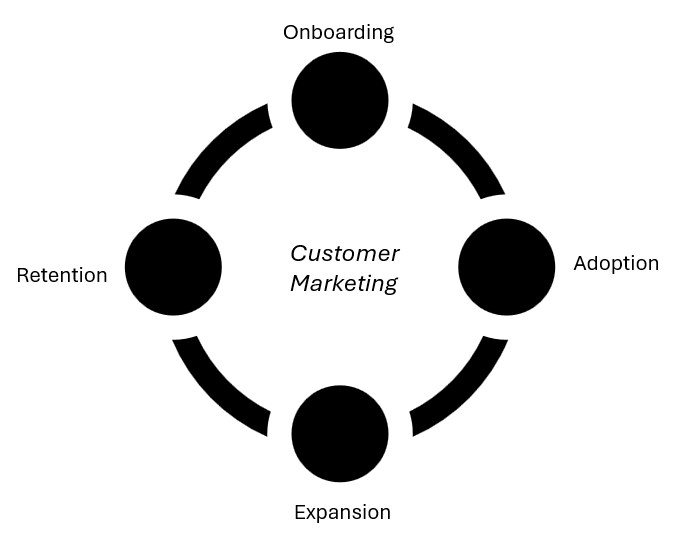
Onboarding: Customer marketing can support new customers by crafting programs that simplify the process of getting started with your product.. I have seen this done well for PLG (Product Led Growth) companies, but this is also important for sales-driven growth models. For example, develop high-value webinars where existing customers share what worked for them. Or develop onboarding content with examples from customer use cases. The content and webinars should include best practices, the nitty-gritty stuff, what to avoid, what worked, etc., to help new customers get started with your product. Happy existing customers love to share this information – and your new customers will appreciate it. You can partner with your customer success organization for such activities. It will help your new customers get going with your product quickly and improve their time-to-value, which is important for expansion and retention. Once you help get them onboarded easily with your content and marketing (where they found value), it also makes it easier to get ‘opt-in permission’ from them for future marketing activities.
Adoption/Growth: Once the customer is onboarded, it is important to ensure they are beginning to get value from your product. While this is the primary job of your customer success organization in working 1:1 with the customer, you can help them with N:1 marketing. Get your successful customers and implementation partners to share use cases, technical/functional insights, and specific steps they took to get there. Ensure this is not just at a high level but at the level of detail that helps the users of your product understand how to deploy additional use cases. This also helps create opportunities for up-sell in the future – adding more users or however you license your product. You can also include such sessions in the agenda for your annual marketing events. I want to share an interesting example of such a program. This software vendor had multiple versions of their hosted cloud product, and their customers were stuck on older releases. Migration to newer releases needed additional technical expertise. However, the customers did not have the budget to use external consultants, and the internal team did not have all the answers. I created monthly one-hour webinar sessions, where professional services staff held ‘professor hours.’ Any customers could call into the webinar, ask open-ended questions, and get answers to them – at any level of detail. It also added value to other customers who were on the call. This helped many customers get past the roadblocks and move to newer releases – a win-win for both the customer and the vendor. Even the professional services team members got a lot of job satisfaction by spending one hour with multiple customers and helping them move forward.
Expansion (cross-sell) programs: As I shared in my previous blog, use land and expand analysis of your sales data to identify various cross-sell paths. It helps you understand a) which products customers in specific industry/firmographic segments or geographic areas typically start with, b) what products they add, in what sequence, and the triggers for that expansion. These insights help you identify cohort groups of cross-sell candidates within your customer base and the products you should cross-sell to them. It’s like having the ‘intent data’ at your fingertips based on their internal usage and the pattern you have seen for expansion from your ‘land and expand’ analysis of your past sales data. You can use this data to create high-impact cross-sell campaigns.
Renewal programs: One of the goals of your CSM organization is to show the value the customer is currently getting from your product and help them increase it during the license term, so renewal becomes easier. However, marketing can significantly contribute by amplifying the value received by different customers and showcasing the diverse use cases implemented across the customer community. Providing insight into the benefits enjoyed by peers in the industry can be particularly helpful if there’s any uncertainty among your customers’ executives about renewing. Customer success stories (value engineering-based), community activities, and metrics-driven webinars can play a big role.
I have seen too many customer marketing programs focused on creating ineffective customer case studies and cross-sell campaigns. The case studies are very high-level and typically designed to be used in the sales cycle (primarily covering challenges they faced before purchasing the solution, evaluation process, implementation timeline and some very high level benefits obtained) rather than for the post-sales customer lifecycle (scope of deployment, use cases implemented, specific metrics improved, key learnings, future plans etc.). In addition, their cross-sell campaigns are typically ‘spray and pray’ – they are designed without any foundational ‘land and expand’ analysis. As a result, customer marketing programs fail to make an impact on customer adoption, expansion, and retention.
If you need help streamlining your customer marketing program to help improve your adoption, expansion, and retention metrics, please contact me via LinkedIn.
 All Things SaaS
Leave a comment